









Always in sync, even across episodes
No more "wait, let me pause" moments. Our sync engine keeps everyone frame-perfect—even when you binge multiple episodes in one party.
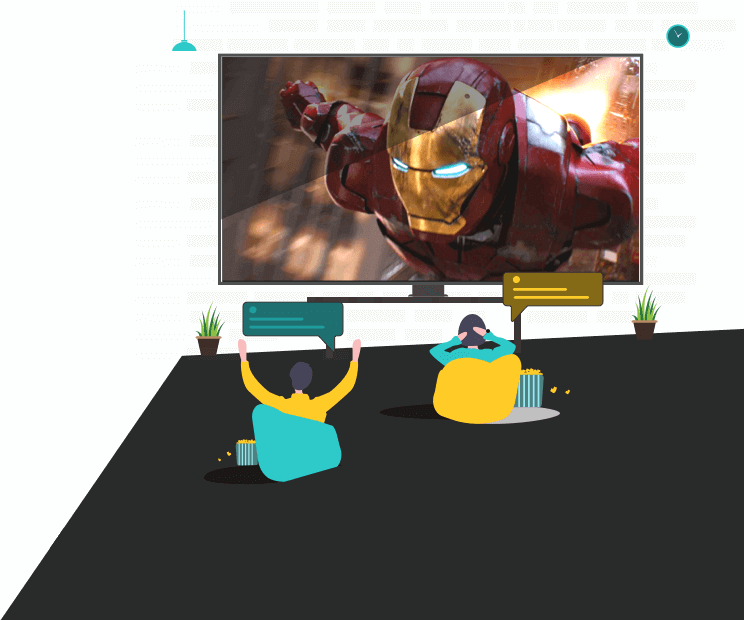
Start playing any video on Netflix, Disney+, or 10+ supported platforms.
Click the Flickcall logo on top right once video starts or hit the Flickcall icon on chrome toolbar. Your watch party is ready in one click.
Copy the party link and send it to your friends. They join with one click—no sign-up required.
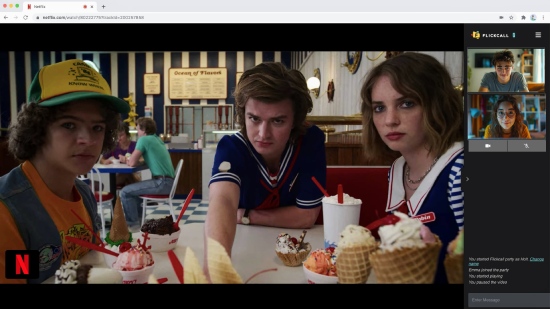
Create watch parties on Netflix, Disney+, JioHotstar, JioHotstar, HBO Max, MAX, Hulu, Prime Video, Youtube, Zee5, Sony Liv, JioHotstar with Flickcall.

No more "wait, let me pause" moments. Our sync engine keeps everyone frame-perfect—even when you binge multiple episodes in one party.

Catch your friends gasping at plot twists. Share laughter in real-time. Video chat makes every watch party feel like you're on the same couch.

Install the extension, play any video, click the Flickcall icon. That's it—share the link and you're watching together.
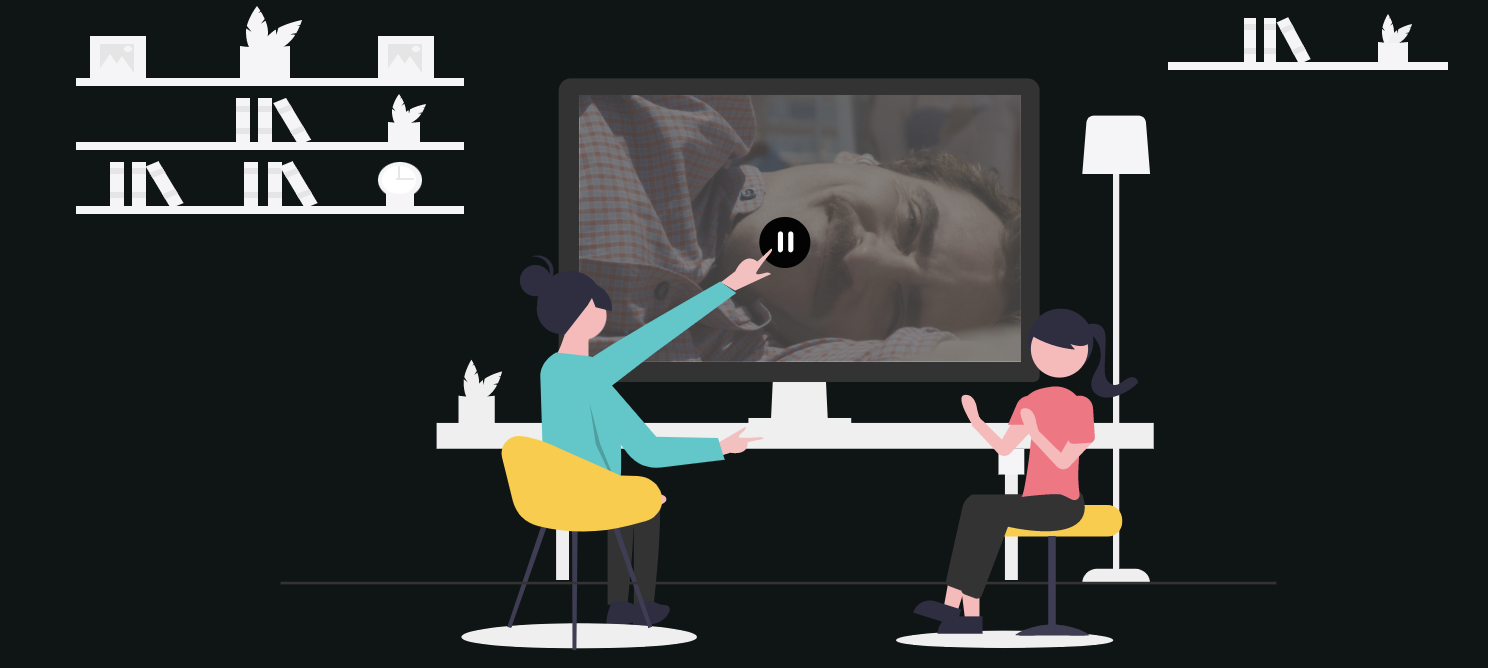
When you pause video, your mic unmutes. When you play, it mutes. Smart Mic knows when you need to talk. No fumbling with buttons, just natural conversation.
We use peer-to-peer technology to connect you directly with your friends. Your video calls and chats are never routed through our servers unless direct connection is blocked*.
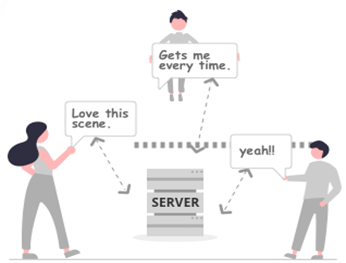
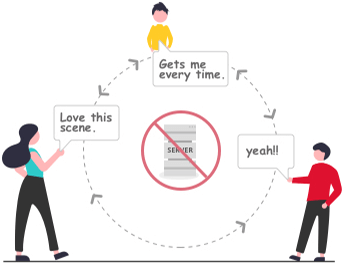
* In some cases, firewall setting doesn't allow direct connection, the calls and messages are encrypted and transmitted via routing servers.
And then there’s the afterlife of the file: saved versions multiply like postcards, some labeled V2_final_FINAL, others hidden in forgotten folders. Each iteration keeps a trace of the artist’s doubts and delights, the slow decisions made between grain and glow. In this archive, Portraiture 234 is not merely a plugin but a companion in the long conversation of making—an aide in the quest to present people not as perfected mannequins but as luminous, flawed beings.
If you wander the net’s bazaars looking for that exact filename, you’ll find many echoes — versions, updates, and forks — each reflecting how we try to reconcile authenticity and polish. The conversation around tools like this is less about theft or scarcity and more about ethics and intention: when smoothing becomes erasing, when enhancement slips into replacement. But used with care, the effect is a gentle translation: the raw, human subject rendered with tenderness by an algorithm that knows when to step back.
Imagenomic Portraiture 234 Photoshop Plugin — a glittering phrase, a file name like a small myth stitched into the web. Imagine a neon-splattered city of pixels where every portrait is a streetlamp: some burn steady and soft, others buzz with color and edge. In that city lives Portraiture 234, an artisan’s ghost in plugin form — part algorithm, part painter’s hand — promising to smooth the grit of skin into satin while keeping the soul’s tiny constellations intact.
So picture a screen: midnight blue interface, a row of sliders like the controls of a small ship steering a human face through light. Nudge clarity, breathe out noise, preserve color — and there it is, a portrait that feels like the person remembered themselves well. Portraiture 234 is a small myth for a large digital age: a reminder that every image we touch is a story we choose to tell, and that even in an era of plugins and presets, the act of seeing remains profoundly, gloriously human.
Think of the plugin as a curious conservator: it approaches a face not like a factory pressing out defects but like a careful restorer removing dust from an old photograph. It eases textures, whispers away distractions, yet refuses to bleach out expression. Cheekbones catch the light like polished coins; laugh lines are kept as maps of lived terrain. The slider becomes a temper, the mask a secret handshake between human and software — one click can be mercy, two can be art.
And then there’s the afterlife of the file: saved versions multiply like postcards, some labeled V2_final_FINAL, others hidden in forgotten folders. Each iteration keeps a trace of the artist’s doubts and delights, the slow decisions made between grain and glow. In this archive, Portraiture 234 is not merely a plugin but a companion in the long conversation of making—an aide in the quest to present people not as perfected mannequins but as luminous, flawed beings.
If you wander the net’s bazaars looking for that exact filename, you’ll find many echoes — versions, updates, and forks — each reflecting how we try to reconcile authenticity and polish. The conversation around tools like this is less about theft or scarcity and more about ethics and intention: when smoothing becomes erasing, when enhancement slips into replacement. But used with care, the effect is a gentle translation: the raw, human subject rendered with tenderness by an algorithm that knows when to step back. And then there’s the afterlife of the file:
Imagenomic Portraiture 234 Photoshop Plugin — a glittering phrase, a file name like a small myth stitched into the web. Imagine a neon-splattered city of pixels where every portrait is a streetlamp: some burn steady and soft, others buzz with color and edge. In that city lives Portraiture 234, an artisan’s ghost in plugin form — part algorithm, part painter’s hand — promising to smooth the grit of skin into satin while keeping the soul’s tiny constellations intact. If you wander the net’s bazaars looking for
So picture a screen: midnight blue interface, a row of sliders like the controls of a small ship steering a human face through light. Nudge clarity, breathe out noise, preserve color — and there it is, a portrait that feels like the person remembered themselves well. Portraiture 234 is a small myth for a large digital age: a reminder that every image we touch is a story we choose to tell, and that even in an era of plugins and presets, the act of seeing remains profoundly, gloriously human. Imagenomic Portraiture 234 Photoshop Plugin — a glittering
Think of the plugin as a curious conservator: it approaches a face not like a factory pressing out defects but like a careful restorer removing dust from an old photograph. It eases textures, whispers away distractions, yet refuses to bleach out expression. Cheekbones catch the light like polished coins; laugh lines are kept as maps of lived terrain. The slider becomes a temper, the mask a secret handshake between human and software — one click can be mercy, two can be art.