
Dadatu 98 [best] 【INSTANT】
I should structure the story with a clear beginning, middle, and end. Introduce Dadatu as a central figure, maybe a leader or guardian of knowledge. Then present a conflict or challenge he faces, and resolve it through his wisdom or actions. Include elements that reflect cultural values, like community cooperation, respect for elders, or harmony with nature.
Finally, summarize the story's key points and provide a satisfying conclusion. Make sure it's suitable for any age group but perhaps lean towards a family-friendly tone unless specified otherwise. Also, keep the language simple and engaging to maintain readability.
"The roots are the memories. Tend them, and they will always bear fruit." The tale of Dadatu 98 lives on, a reminder that guardianship begins with humility—and that the land, though silent, will always speak if you dare to listen. Dadatu 98
Dadatu’s weathered hands traced the patterns in the soil. “The forest grows restless,” he murmured. “Long ago, when greed crept into human hearts, we forgot how to listen to the land.” That night, strange tremors rattled the ground, and the banyan tree’s leaves turned crimson, a sign of warning. Guided by a dream of glowing butterflies and a whisper from the wind, Dadatu summoned the courage to journey into the heart of the sacred grove. Milo followed, driven by curiosity and duty. They traversed paths of mossy stones until they reached a hidden spring, once clear as crystal but now murky with decay. At its center stood a stone effigy of the forest guardian, its face etched with sorrow.
Years later, long after Dadatu’s spirit danced with the ancestors, the forest remained vibrant, and the people remembered. For they learned that wisdom is not in knowing answers, but in listening—and that even the oldest stories can birth new life. To this day, the banyan tree’s leaves shimmer with a hint of crimson when the elders warn of balance. And if you walk the grove at twilight, you might hear a low hum—a melody Dadatu once sang to the wind. I should structure the story with a clear
In the heart of an ancient village nestled between emerald hills and whispering mangrove forests lived a revered elder named Dadatu 98. Though his hair was as silver as the moonlit tides and his back bowed with age, his eyes sparkled with the wisdom of a thousand stories. For 98 years, he had tended to the sacred grove, a mystical forest said to hold the breath of the ancestors and the secrets of the land. The villagers sought Dadatu’s guidance for all matters, from planting crops during the monsoon rains to resolving disputes. His wisdom was passed down through generations, etched like the roots of an ancient banyan tree that stood at the forest’s edge. One day, as the sun dipped low, casting orange shadows over the village, a young boy named Milo approached him. “Father, the rivers have dried, and the birds no longer sing,” he pleaded. “Why is the world forgetting us?”
Dadatu knelt and wept, recalling a forgotten ritual. “We must offer our story,” he told Milo. “Not in words, but in silence. Let the roots hear our truth.” For three days and three nights, the duo sat by the spring, sharing their fears, their gratitude, and the promises they’d long broken. As dawn broke on the third day, the spring bubbled with renewed life, its water clear and cool. When they returned to the village, the forest began to heal. The rivers trickled back to life, and birds returned in flocks of color. Dadatu, now known as Kabayan (“Elder Brother”) to all, taught the village to farm sustainably, to plant for the future, and to honor the voices of stones, trees, and stars. He passed a new tradition to Milo: every spring, the villagers would gather at the banyan tree to share stories of gratitude and renewal. Also, keep the language simple and engaging to
I should consider that "Dadatu" could be a character name in a story, maybe from Southeast Asian folklore since "datu" is a term used in the Philippines and Indonesia for a chief or leader. The number 98 might be part of the name or an age, like a 98-year-old father or ancestor.
eFatigue gives you everything you need to perform state-of-the-art fatigue analysis over the web. Click here to learn more about eFatigue.
Dadatu 98 [best] 【INSTANT】
Welds may be analyzed with any fatigue method, stress-life, strain-life or crack growth. Use of these methods is difficult because of the inherent uncertainties in a welded joint. For example, what is the local stress concentration factor for a weld where the local weld toe radius is not known? Similarly, what are the material properties of the heat affected zone where the crack will eventually nucleate. One way to overcome these limitations is to test welded joints rather than traditional material specimens and use this information for the safe design of a welded structure.
One of the most comprehensive sources for designing welded structures is the Brittish Standard Fatigue Design and Assessment of Steel Structures BS7608 : 1993. It provides standard SN curves for welds.
Weld Classifications
For purposes of evaluating fatigue, weld joints are divided into several classes. The classification of a weld joint depends on:
- the macroscopic geometry of the pieces welded,
- the direction of the cyclic stresses, and
- the location of the crack that leads to failure.
Two fillet welds are shown below. One is loaded parallel to the weld toe ( Class D ) and the other loaded perpendicular to the weld toe ( Class F2 ).
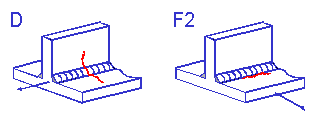
It is then assumed that any complex weld geometry can be described by one of the standard classifications.
Material Properties
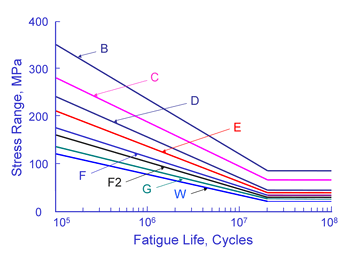
The curves shown above are valid for structural steel welds. Fatigue lives are not dependant on either the material or the applied mean stress. Welds are known to contain small cracks from the welding process. As a result, the majority of the fatigue life is spent in growing these small cracks. Fatigue lives are not dependant on material because all structural steels have about the same crack growth rate. The crack growth rate in aluminum is about ten times faster than steel and aluminum welds have much lower fatigue resistance. Welding produces residual stresses at or near the yield strength of the material. The as welded condition results in the worst possible residual or mean stress and an external mean stress will not increase the weld toe stresses because of plastic deformation. Fatigue lives are computed from a simple power function.

The constant C is the intercept at 1 cycle and is tabulated in the standard. This constant is much larger than the ultimate strength of the material.
The standard is only valid for fatigue lives in excess of 105 cycles and limits the stress to 80% of the yield strength. Experience has shown that the SN curves provide reasonable estimates for higher stress levels and shorter lives. In eFatigue, the maximum stress range permitted is limited by the ultimate strength of the material for all weld classes.
Design Criteria
Test data for welded members has considerable scatter as shown below for butt and fillet welds.
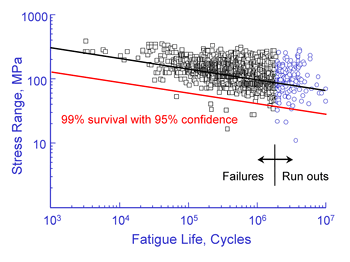
Some of this scatter is reduced with the classification system that accounts for differences between the various joint details. The standard give the standard deviation of the various weld classification SN curves.
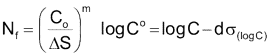
The design criteria d is used to determine the probability of failure and is the number of standard deviations away from the mean. For example d = 2 corresponds to a 2.3% probability of failure and d = 3 corresponds to a probability of failure of 0.14%.
© 2026 — Urban Domain