Welcome back!
Ready to check out?
You're just one click away from fantastic style and even better savings!
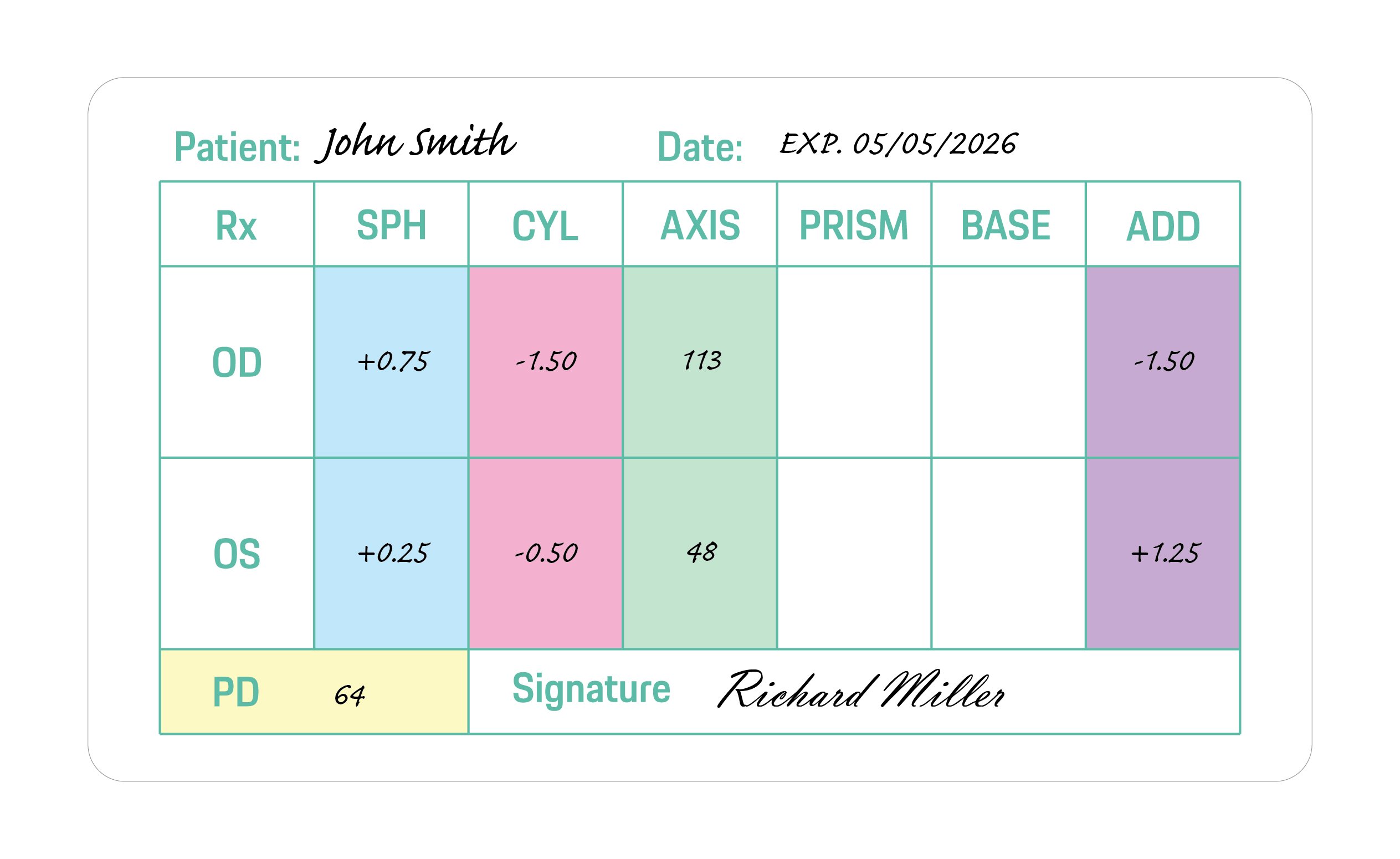
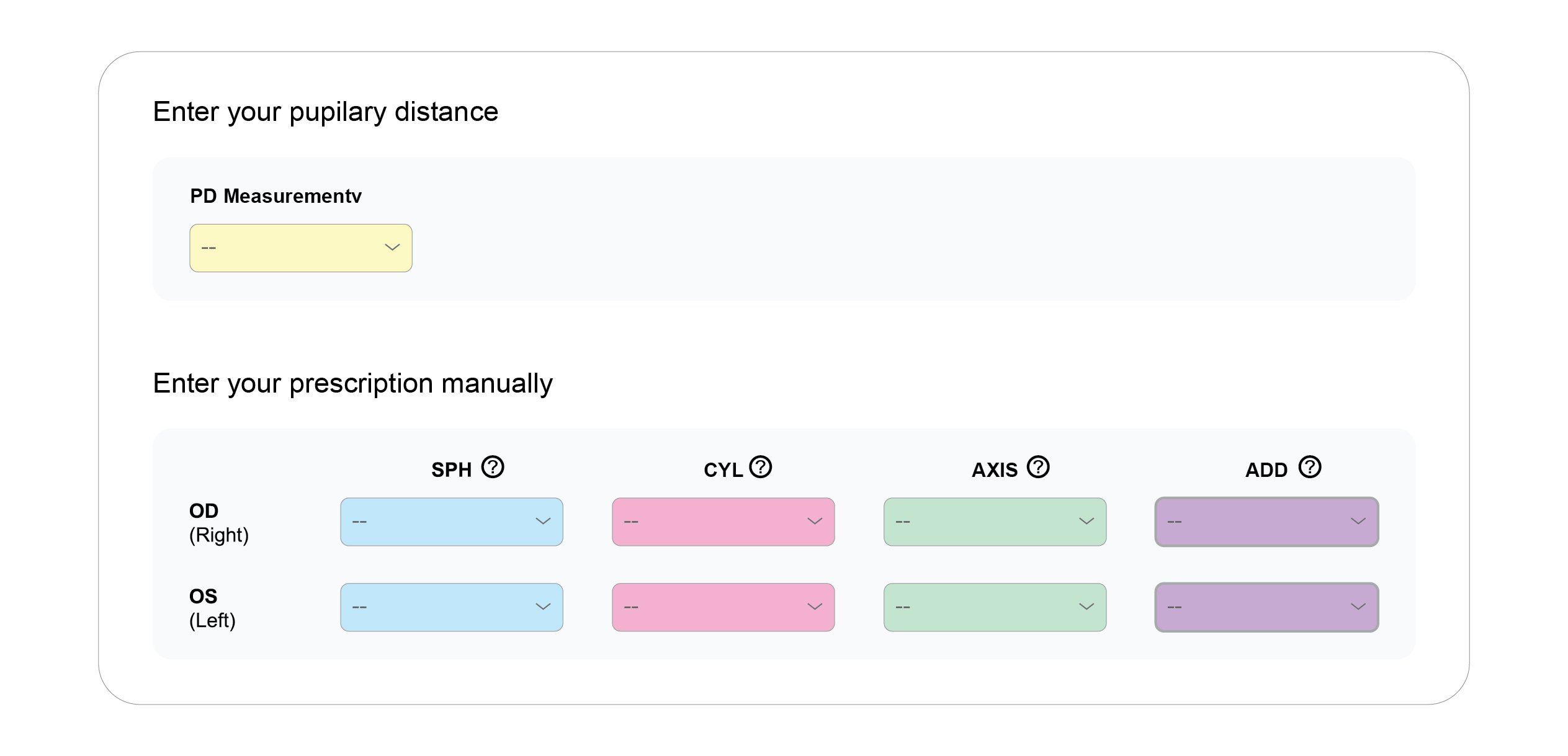
OD is an abbreviation for the Latin term oculus dexter which means right eye. Notice that the right eye information is asked for first even though we typically read from left to right.
OS is an abbreviation of the Latin oculus sinister which means left eye. That will be referenced on the far right column of the prescription.
SPH is short for sphere. The sphere of your prescription indicates the power on the lenses that is needed to see clearly. A plus (+) symbol indicates the eyeglass wearer is farsighted. A minus (-) symbol indicates that the eyeglass wearer is nearsighted.
CYL is short for cylinder. The cylinder indicates the lens power necessary to correct astigmatism. If the column has no value (is blank), it indicates that the eyeglass wearer does not have astigmatism. If this is the case on your prescription, you can leave it blank when entering it in.
AXIS is a prescription will include an axis value for those with astigmatism. This number represents the angle of the lens that shouldn't feature a cylinder power to help correct your astigmatism.
ADD is short for "additional correction." This is where details about bifocals, multifocal lenses or progressive lenses would appear.
Final resonance: not just what you learn, but who you become Assimil’s Italian audio does something subtle and profound: it tunes your ear to a new social universe. As you internalize rhythm, tone, and idiom, you don’t just learn to ask for directions—you learn to belong, in small, honest ways, to Italian conversational life. That is the real power of the audio: it converts information into intimacy, vocabulary into voice. Use it right, and the language stops being foreign and starts becoming yours.
Native speakers, authentic voices A crucial reason the audio grips learners is authenticity. Professional native speakers, often with subtle regional coloring, provide real-world models: clipped Florentine consonants, the melodic rise of Neapolitan inflection, the clipped cadence of northern registers. These nuances teach you what textbooks rarely do—the social weight of a phrase, where to soften consonants for affection, how to cut a sentence for emphasis. Hearing a native voice use a phrase casually helps you understand not only meaning but appropriateness: formality vs. familiarity, irony vs. sincerity. assimil italian audio
Dialogues as lived moments Where grammar charts feel inert, the audio dialogues breathe. Small scenes—ordering coffee, apologizing, arranging a meeting—unfold like tiny plays. The listener becomes an eavesdropper, then a participant. This dramatization anchors vocabulary in social function. More than learning words, you pick up conversational choreography: when to interrupt, how to show politeness, how to escalate or de-escalate. That pragmatic competence is the thin line between sounding textbook-perfect and sounding genuinely Italian. Final resonance: not just what you learn, but
Pitfalls and how audio defangs them Not all audio use is productive. Common pitfalls include endless passive play without active engagement, slavish imitation that freezes you into mimicry rather than conversational use, and skipping shadowing because it feels awkward. The cure is discipline: structured, varying practice sessions; combining audio with output (speaking/writing); and accepting early disfluency as part of the learning curve. Use it right, and the language stops being
Assimil’s Italian course is more than a language book: it’s a whispering companion that slowly rewrites how you think, hear, and speak. At the heart of that metamorphosis is the audio—an element too often dismissed as ancillary, but which, when fully leveraged, transforms passive study into living conversation. This essay traces how Assimil’s audio works its quiet alchemy, why it grips learners, and how to squeeze every last drop of value from those recordings.
Beyond pronunciation: cultural transfer Audio carries culture. A speaker’s laugh, hesitancy, the way apology is softened or directness asserted—these are cultural signals. Assimil’s recordings often encode such cues, giving learners a sense of Italian sociability: warmth that’s performative, brusqueness that can be affectionate, the ritual of small talk. This cultural competence reduces the risk of pragmatic faux pas and enhances empathy in real interaction.
The arc of progression Audio learning via Assimil feels like moving from the margins of a language into its center. Early days are about mapping sounds and building a phonetic sense. Midway, you begin to anticipate phrases and respond internally. Later, audio becomes rehearsal—polishing accents, expanding expressive range, and improvising. The trajectory is less a straight line and more a spiral: each pass goes deeper, fresher subtleties revealed.
*Discount applied on the current website price at the time of order. Offer only valid for new customer first contacts order over $10. Maximum discount of $100. Cannot be combined with any other offers. Promotions are subject to change without notice. We reserve the right to cancel orders that are in breach of the terms and conditions of this offer.



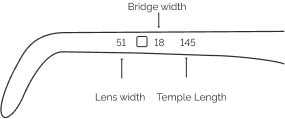
| Lens Width | Bridge Width | Temple Length | |
|---|---|---|---|
| XS | < 42 mm | < 16 mm | <=128 mm |
| S | 42 mm - 48 mm | 16 mm - 17 mm | 128 mm - 134 mm |
| M | 49 mm - 52 mm | 18 mm - 19 mm | 135 mm - 141 mm |
| L | >52 mm | >19 mm | >= 141 mm |
Buying eyewear should leave you happy and good-looking. Use our sizing tool to find frames that best fit your unique facial measurements.
Grab a regular card with a magnetic stripe on the back. Student IDs, credit cards and gift cards work well to start our online PD tool.
You may have received our paper PD measurement tool in your recent online order. In order to use this tool, place the ruler on your eyes so that the "0" lines up at the centre in between your eyes. Add up the two numbers, to get your PD. See example below:
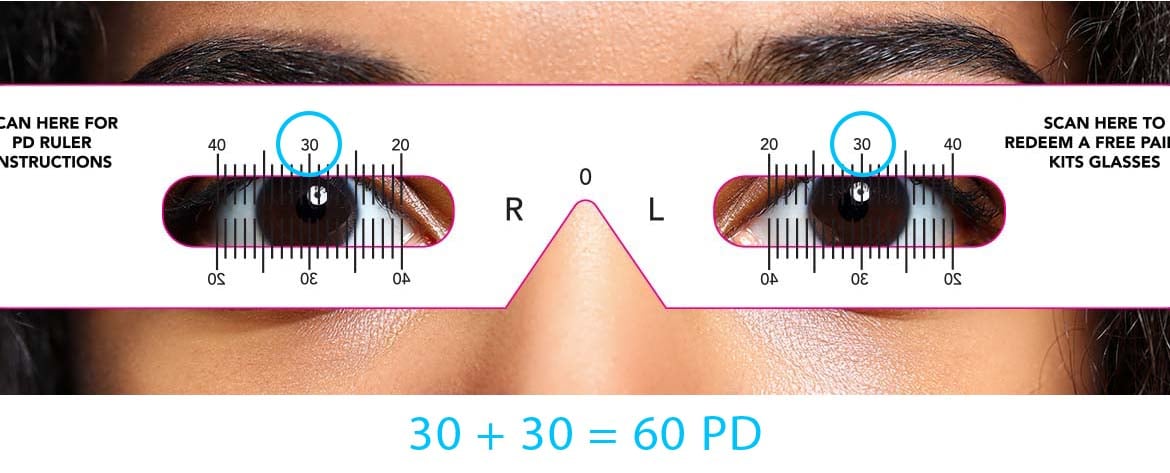
Click on this link to download and print your own PD measurement tool.
DOWNLOAD



 Check order status
 Place reorder
 Chat with us





 Use your insurance
 Help
Help